
About
I am an interdisciplinary researcher and new media artist studying the evolution of computational cognition across systems, from cellular sensing to complex cognition and the philosophy of computation as it applies to biology. My work brings together computational cognitive neuroscience, evolutionary biology, unconventional computing, and Science and Technology Studies.
My training comes from Design and Computation at MIT (SMArchS) Cognitive Science and Artificial Intelligence through MIT CSAIL, and Evolutionary Neuroscience in the Krubitzer Lab at UC Davis (MS), where I studied how sensory processing regions in the cortex vary across mammals.
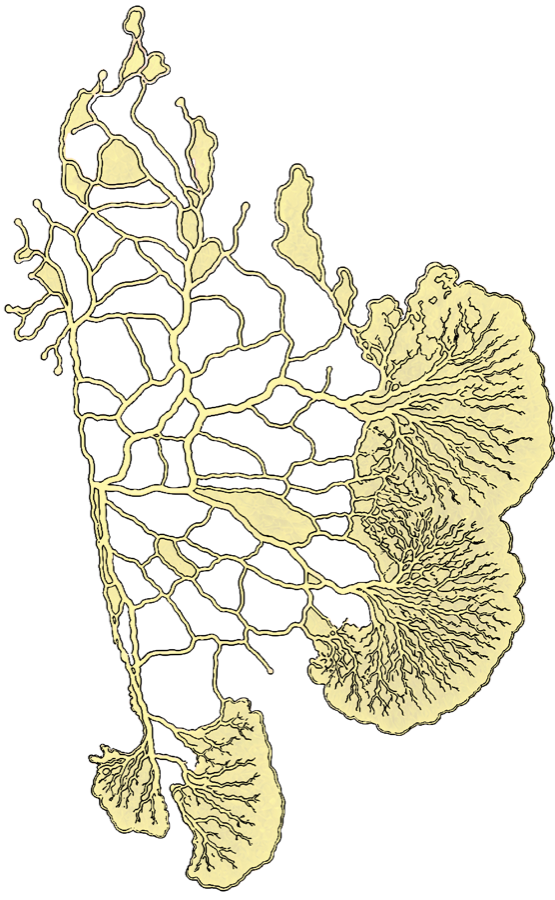
I am currently pursuing a PhD at UC Davis. My doctoral work uses computational models to explore information processing in Physarum polycephalum, including its development from uninucleate amoebae into a multinucleate networked plasmodium, into multicellularity. In parallel, my work in Critical Simulation Studies examines what biological models represent, omit, or distort.
I am fascinated by the complex evolution of fungi, slime molds, parasitic plants and parasitoid wasps. They will probably find their way onto this site too.
Research
Life evolves through molecular substrates that are inseparable from information-based ones. It depends as much on information as the materials and energy that support information processes. Natural environments contain a diverse and vast amount of potentially useful signals. Yet, organisms become selectively attuned to specific subsets of those signals, rendering them biologically meaningful through representations and responses. I use cognition broadly to describe how living things detect information (sensing), encode information (memory), compress, structure and generalize from information (causal inference, world models).
My current research explores whether evolution draws on conserved computational “building blocks” of information processing that recur in different combinations to produce diverse forms of cognition, or whether similar capacities in different organisms are emergent and fundamentally different. My goal is to develop comparative ways of characterizing what is shared and what differs across biological and artificial systems, including their representations, dynamics, constraints, and energy-information tradeoffs. I seek to identify the conditions under which different systems arise and to contribute to empirical and theoretical frameworks that allow us to characterize differences in computational properties across substrates and scales.
I also work on epistemic questions about biology and computational modeling: When different models produce the same lifelike behaviors, what enables deeper explanatory insight into biology? What assumptions about “what life is” and “what computation is” are embedded in experiments, models, and conceptual frameworks? My current dissertation examines where living systems cannot be captured by our models of them, how the places where our models fail can become sources of insight, and how concepts of information and the separation of scales or levels of analysis shape explanation in biology.